Monday, June 17, 2013

ELASTOMERIC COATINGS - WATERPROOFING OF BUILDINGS

Paints and elastomeric coatings are similar in that they always contain three basic elements in a liquid state: pigment, binder, and solvent. In addition, both often contain special additives such as mildew-resistant chemicals. However, paints and coatings differ in their intended uses.

Paints are applied only to add decorative color to a substrate. Coatings are applied to water- proof or otherwise protect a substrate. The difference between clear sealers and paints or coatings is that sealers do not contain the pigments that provide the color of paints or coatings.

Solvent is added to paints and coatings to lower the material viscosity so it can be applied to a substrate by brush, spray, or roller. The binder and solvent portion of a paint or coating is referred to as the vehicle. A coating referred to as 100 percent solids is merely a binder in a liquid state that cures, usually moisture cured from air humidity, to a seamless film upon application. Thus it is the binder portion, common to all paints and coatings, that imparts the unique characteristics of the material, differentiating coatings from paints.

Waterproof coatings are classified generically by their binder type. The type of resin materials added to the coating imparts the waterproofing characteristics of the coating material. Binders are present in the vehicle portion of a coating in either of two types. An emulsion occurs when binders are dispersed or suspended in solvent for purposes of application. Solvent-based materials have the binder dissolved within the solvent.

The manner in which solvents leave a binder after application depends upon the type of chemical polymer used in manufacturing. A thermoplastic polymer coating dries by the solvent evaporating and leaving behind the binder film. This is typical of water-based acrylic elastomeric coatings used for waterproofing. A thermosetting polymer reacts chemically or cures with the binder and can become part of the binder film that is formed by this reaction. Examples are epoxy paints, which require the addition and mixing of a catalyst to promote chemical reactions for curing the solvent.

The catalyst prompts a chemical reaction that limits application time for these materials before they cure in the material container. This action is referred to as the “pot life” of material (workability time). The chemical reactions necessary for curing create thermosetting polymer vehicles that are more chemically resistant than thermoplastic materials.

Thermosetting vehicles produce a harder film and have an ability to contain higher solids content than thermoplastic materials.

Resins used in elastomeric coatings are breathable. They allow moisture-vapor trans- mission from the substrate to escape through the coating without causing blisters in the coating film. This is a favorable characteristic for construction details at undersides of bal- conies that are subjected to negative moisture drive. Thermosetting materials such as epoxy paints are not breathable. They will blister or become unbonded from a substrate if subjected to negative moisture drive.

Resins

Elastomeric coatings are manufactured from acrylic resins with approximately 50 percent solids by volume. Most contain titanium dioxide to prevent chalking during weathering.

Additional additives include mildewcides, alkali-resistant chemicals, various volume extenders to increase solids content, and sand or other fillers for texture. Resins used in waterproofing coatings must allow the film to envelop a surface with sufficient dry film millage (thickness of paint measured in millimeters) to produce a film that is watertight, elastic, and breathable. Whereas paints are typically applied 1–4 mil thick, elastomeric coatings are applied 10–20 mil thick.

It is this thickness (with the addition of resins or plasticizers that add flexibility to the coating) that creates the waterproof and elastic coating, thus the term elastomeric coating.

Elastomeric coatings have the ability to elongate a minimum of 300 percent at dry millage thickness of 12–15 mil. Elongation is tested as the minimum ability of a coating to expand and then return to its original shape with no cracking or splitting (tested according to ASTM D-2370). Elongation should be tested after aging and weathering to check effec- tiveness after exposure to the elements.

Elastomeric coatings are available in both solvent-based and water-based vehicles.  Water-based vehicles are simpler to apply and not as moisture-sensitive as the solvent- based vehicles. The latter are applied only to totally dry surfaces that require solvent materials for cleanup.

Typical properties of a high-quality, waterproof, and elastic coating include the following:

● Minimum of 10-mil dry application
● High solids content (resins)
● Good ultraviolet weathering resistance
● Low water absorption, withstanding hydrostatic pressure
● Permeability for vapor transmission
● Crack-bridging capabilities
● Resistance to sulfites (acid rain) and salts
● Good color retention and low dirt pickup
● High alkali resistance

Acrylic coatings are extremely sensitive to moisture during their curing process, taking up to 7 days to cure. Should the coating be subjected to moisture during this time, it may reemulsify (return to liquid state). This becomes a critical installation consideration when- ever such coatings are used in a horizontal or slightly inclined surface that might be susceptible to ponding water.

Elastomeric coating installations

Elastomeric coatings, which are used extensively on stucco finish substrates and exterior insulation finish systems (EIFS), are also used on masonry block, brick, concrete, and wood substrates. Some are available with asphalt primers for application over asphalt finishes. Others have formulations for use on metal and sprayed urethane foam roofs.

Elastomeric coatings are also successfully used over previously painted surfaces. By cleaning, preparing the existing surface, repairing cracks (Fig. 3.12), and priming, coatings can be used to protect concrete and masonry surfaces that have deteriorated through weathering and aging (Fig. 3.13).

Preparation of substrate including crack repair prior to elastomeric coating application.
FIGURE 3.12 Preparation of substrate including crack repair prior to elastomeric coating
application.
Application of elastomeric coating
FIGURE 3.13 Application of elastomeric coating
Proper preparation, such as tuck-pointing loose and defective mortar joints and injecting epoxy into cracks, must be completed first. In single-wythe masonry construction, such as split-face block, applying a cementitious block filler is necessary to fill voids in the block before applying elastomeric coating for effective waterproofing.

Aesthetically, coatings are available in a wide range of textures and are tintable to any imaginable color. However, deep, dark, tinted colors may fade, or pigments added for coloring may bleed out creating unsightly staining. Heavy textures limit the ability of a coating to perform as an elastomeric due to the amount of filler added to impart texture.

Because elastomeric coatings are relatively soft materials (lower tensile strength to impart flexibility), they tend to pick up airborne contaminants. Thus lighter colors, including white, may get dirty quickly.

Uniform coating thickness is critical to ensure crack bridging and thermal movement capabilities after application. Applicators should have wet millage gages for controlling the millage of coating applied.

Applications of elastomeric coatings are extremely labor-sensitive. They require skilled application of the material. In addition, applicators must transition coating applications into adjacent members of the building envelope, such as window frames and flashings, for effective envelope waterproofing. (See Table 3.13.)

Monday, June 10, 2013

CEMENTITIOUS COATING APPLICATION

For adequate bonding to substrates, surfaces to receive cementitious coatings should be cleaned of contaminants including dirt, efflorescence, form-release agents, laitance, residues of previous coatings, and salts. Previously painted surfaces must be sandblasted or chemically cleaned to remove all paint film.

Cementitious coating bonding is critical to successful in-place performance. Therefore, extreme care should be taken in preparing substrates for coating application. Sample applications for bond strength should be completed if there is any question regarding the acceptability of a substrate, especially with remedial waterproofing applications.

Poured-in-place or precast concrete surfaces should be free of all honeycombs, voids, and fins. All tie holes should be filled before coating application with nonshrink grout material as recommended by the coating manufacturer. Although concrete does not need to be cured before cementitious coating application, it should be set beyond the green stage of curing. This timing occurs within 24 hours after initial concrete placement.

With smooth concrete finishes, such as precast, surfaces may need to be primed with a bonding agent. In some instances a mild acid etching can be desirable, using a muriatic acid solution and properly rinsing substrates before the coating application. Some manufacturers require a further roughing of smooth finishes, such as sandblasting, for adequate bonding.

On masonry surfaces, voids in mortar joints should be filled before coating installation.
With both masonry and concrete substrates, existing cracks should be filled with a dry mix of cementitious material sponged into cracks. Larger cracks should be sawn out, usually to a 3 4 in minimum, and packed with nonshrink material as recommended by the coating manufacturer.

Moving joints must be detailed using sealants designed to perform under the expected movement. These joints include thermal movement and differential movement joints. The cementitious material should not be applied over these joints as it will crack and “alligator” when movement occurs.

If cracks are experiencing active water infiltration, this pressure must be relieved before coating is applied. Relief holes should be drilled in a substrate, preferably at the base of the wall, to allow wicking of water, thus relieving pressure in the remainder of work areas during coating application. After application and proper curing time (approximately 48–72 hours), drainage holes may then be packed with a nonshrink hydraulic cement material and finished with the cementitious coating.

After substrate preparations are completed and just before application, substrates must be wetted or dampened with clean water for adequate bonding of the coating. Substrates must be kept continually damp in preparation for application. The amounts of water used are dependent on weather and substrate conditions. For example in hot, dry weather, substrates require frequent wettings. Coatings should not be applied in temperatures below 40°F or in conditions when the temperature is expected to fall below freezing within 24 hours after application.

Cementitious coatings should be carefully mixed following the manufacturer’s recommended guidelines concerning water ratios. Bonding agents should be added as required with no other additives or extenders, such as sand, used unless specifically approved by the manufacturer. With smooth surfaces such as precast concrete, an additional bonding agent is required.

Cementitious coatings may be applied by brush, trowel, or spray. Stiff, coarse, or fiber brushes are used for application. Brush applications require that the material be scrubbed into a substrate, filling all pores and voids. Finish is completed by brushing in one direction for uniformity.

Spray applications are possible by using equipment designed to move the material once mixed. Competent mechanics trained in the use of spray equipment and technique help ensure acceptable finishes and watertightness (Fig. 3.11).

Spray application of cementitious membrane on negative side.
FIGURE 3.11 Spray application of cementitious membrane on negative side.
Trowel applications are acceptable for the second coat of material. Due to the application thickness of this method, manufacturers recommend that silica sand be added to the mix in proper portions. The first coats of trowel applications are actually brush applications that fill voids and pores. Finish trowel coats can be on a continuum from smooth to textured. Sponge finishing of the first coat is used to finish smooth concrete finishes requiring a cementitious application.

With textured masonry units such as split face or fluted block, additional material is required for effective waterproofing. On this type of finish, spraying or brush applications are the only feasible and effective means.

The amount of material required depends upon the expected water conditions. Under normal waterproofing requirements, the first coat is applied at a rate of 2 pounds of material per square yard of work area. The finish coat is then applied at a coverage rate of 1 lb/yd2. In severe water conditions, such as below-grade usage with water-head pressures, materials are applied at 2 lb/yd^2. This is followed by a trowel application at 2 lb/yd2. Clean silica sand is added to the second application at 25 lb of silica to one bag, 50 lb, of premixed cementitious coating.

With all applications, the second material coat should be applied within 24 hours after applying the first coat. Using these application rates, under normal conditions, a 50-pound bag of coating will cover approximately 150 ft 2 (1 lb/yd2 , first coat; 2 lb/yd2 , second coat). The finish thickness of this application is approximately  1 /8 in.

Trying to achieve this thickness in one application, or adding excessive material thickness in one application, should not be attempted. Improper bonding will result, and material can become loose and spall. To eliminate mortar joint shadowing on a masonry wall being visible through the coating, a light trowel coat application should be applied first, followed by a regular trowel application.

The cementitious coating beginning to roll or pull off a substrate is usually indicative of the substrate being too dry; redampening with clean water before proceeding is necessary. Mix proportions must be kept constant and uniform, or uneven coloring or shadowing of the substrate will occur.

After cementitious coatings are applied they should be cured according to the manufacturer’s recommendations. Typically, this requires keeping areas damp for 1–3 days. In extremely hot weather, more frequent and longer cure times are necessary to prevent cracking of the coating. The water cure should not be done too soon after application, as it may ruin or harm the coating finish. Chemical curing agents should not be used or added to the mix unless specifically approved by the coating manufacturer.

Typically, primers are not required for cementitious coating applications, but bonding agents are usually added during mixing. In some cases, if substrates are especially smooth or previous coatings have been removed, a direct application of the bonding agent to substrate surfaces is used as a primer. If there is any question regarding bonding strength, samples should first be applied both with and without a bonding agent and tested before proceeding with the complete application.

Cementitious coatings should not be applied in areas where thermal, structural, or differential movement will occur. Coatings will crack and fail if applied over sealant in control or expansion joints. Cementitious-based products should not be applied over substrates other than masonry substrates such as wood, metal, or plastics,

Tuesday, June 4, 2013

CEMENTITIOUS COATINGS: Properties and Installations

Cementitious-based coatings are among the oldest products used for above-grade water-proofing applications. Their successful use continues today, even with the numerous clear and elastomeric sealers available. However, cementitious systems have several disadvantages, including an inability to bridge cracks that develop in substrates after application.

This can be nullified by installation of control or expansion joints to allow for movement.

In remedial applications where all settlement cracks and shrinkage cracks have already developed, only expansion joints for thermal movement need be addressed.

These coatings are cement-based products containing finely graded siliceous aggregates that are nonmetallic. Pigments are added for color; proprietary chemicals are added for integral waterproofing or water repellency. An integral bonding agent is added to the dry mix, or a separate bonding agent liquid is provided to add to the dry packaged material during mixing. The cementitious composition allows use in both above- and below-grade applications. See Fig. 3.7, for a typical above-grade cementitious application.


Spray application of cementitious waterproofing.
FIGURE 3.7 Spray application of cementitious waterproofing.

Since these products are water-resistant, they are highly resistant to freeze–thaw cycles; they eliminate water penetration that might freeze and cause spalling. Cementitious coatings have excellent color retention and become part of the substrate. They are also non- chalking in nature.

Color selections, such as white, that require the used of white Portland cement, increase material cost. Being cementitious, the product requires job-site mixing, which should be carefully monitored to ensure proper in-place performance characteristics of coatings.

Also, different mixing quotients will affect the dried finish coloring, and if each batch is not mixed uniformly, different finish colors will occur.

Cementitious properties
Cementitious coatings have excellent compressive strength, ranging from 4000 to 6000 lb/in2 after curing (when tested according to ASTM C-109). Water absorption rates of cementitious materials are usually slightly higher than elastomeric coatings. Rates are acceptable for water- proofing, and range from 3 to 5 percent maximum water absorption by weight (ASTM C-67).

Cementitious coatings are highly resistant to accelerated weathering, as well as being salt-resistant. However, acid rain (sulfate contamination) will deteriorate cementitious coatings as it does other masonry products.

Cementitious coatings are breathable, allowing transmission of negative water vapor.

This avoids the need for completing drying of substrates before application, and the spalling that is caused by entrapped moisture. These products are suitable for the exterior of planters, undersides of balconies, and walkways, where negative vapor transmission is likely to occur. Cementitious coatings are also widely used on bridges and roads, to protect exposed concrete from road salts, which can damage reinforcing steel by chloride attack.

Cementitious installations
Water entering masonry substrates causes brick to swell, which applies pressure to adjacent mortar joints.

The cycle of swelling when wet, and relaxing when dry, causes mortar joint deterioration. Cementitious coating application prevents water infiltration and the resulting deterioration. However, coatings alter the original facade aesthetics, and a building owner or architect may deem them not acceptable.

Cementitious coatings are only used on masonry or concrete substrates, unlike elas- tomeric coatings that are also used on wood and metal substrates. Cementitious coating use includes applications to poured-in-place concrete, precast concrete, concrete block units, brick, stucco, and cement plaster substrates (Fig. 3.8). Once applied, cementitious coatings bond so well to a substrate that they are considered an integral part of the substrate rather than a film protection such as an elastomeric coating.

Block cavity wall waterproofing using cementitious waterproofing.
FIGURE 3.8 Block cavity wall waterproofing using cementitious waterproofing.

Typical applications besides above-grade walls include swimming pools, tunnels, retention ponds, and planters (Fig. 3.9). With Environmental Protection Agency (EPA) approval, these products may be used in water reservoirs and water treatment plants. Cementitious coatings are often used for finishing concrete, while at the same time providing a uniform substrate coloring.

Typical detailing of tunnel waterproofing applicable to above-grade applica- tions.
FIGURE 3.9 Typical detailing of tunnel waterproofing applicable to above-grade applications.

An advantage with brick or block wall applications is that these substrates do not nec- essarily have to be tuck-pointed before cementitious coating application. Cementitious coatings will fill the voids, fissures, and honeycombs of concrete and masonry surfaces, effectively waterproofing a substrate (Fig. 3.10).


Waterproofing concrete block envelope with cementitious coating
FIGURE 3.10 Waterproofing concrete block
envelope with cementitious coating

When conditions require, complete coverage of the substrate by a process called bag, or face, grouting of the masonry is used as an alternative. In this process, a cementitious coating is brush applied to the entire masonry wall. At an appropriate time, the cementi-tious coating is removed with brushes or burlap bags, again revealing the brick and mortar joints. The only coating material left is that in the voids and fissures of masonry units and mortar joints. Although costly, this is an extremely effective means of waterproofing a substrate, more effective only than tuck-pointing.

Complete cementitious applications provide a highly impermeable surface and are used to repair masonry walls that have been sandblasted to remove existing coatings and walls that are severely deteriorated. Cementitious applications effectively preserve a facade while making it watertight. Bag grouting application adds only a uniformity to substrate color; colored cementitious products can impart a different color to existing walls if desired. Mask grouting is similar to bag grouting. With mask grouting applications, existing masonry units are carefully taped over, exposing only mortar joints. The coating material is brush-applied to exposed joints, then cured. Tape is then removed from the masonry units, leaving behind a repaired joint surface with no change in wall facade color.

The thickness of coating added to mortar joints is variable but is greater when joints are recessed. This system is applicable only to substrates in which the masonry units themselves, such as brick, are nondeteriorated and watertight, requiring no restoration.

Texture is easily added to a cementitious coating, either by coarseness of aggregate added to the original mix or by application methods. The same cementitious mix applied by roller, brush, spray, hopper gun, sponge, or trowel results in many different texture finishes. This provides an owner or designer with many texture selections while maintaining adequate waterproofing characteristics. A summary of the major advantages and disadvantages of cementitious coatings are given in Table 3.12.

 Cementitious Coating Properties
 Cementitious Coating Properties

In certain instances, such as floor–wall junctions, it is desirable first to apply the cementitious coating to a substrate, and then to fill the joint with sealant material in a color that matches the cementitious coating. The coating will fully adhere to the substrate and is com-patible with sealant materials. It is also possible first to apply cementitious coating to sub- strates, then to apply a sealant to expansion joints, door, and window penetrations, and other joints. This is not possible with clear sealers nor recommended with elastomeric coatings, due to bonding problems.

Cementitious coatings are a better choice over certain substrates, particularly concrete or masonry, than clear sealers or elastomeric coatings. This is because cementitious coat- ings have better bonding strength, a longer life cycle, lower maintenance, and less attrac- tion of airborne contaminants. Provided that adequate means are incorporated for thermal and structural movement, cementitious coatings will function satisfactorily for above-and below-grade waterproofing applications.

Monday, May 27, 2013

WATER-REPELLENT APPLICATION - WATERPROOFING

General surface preparations for all clear water-repellent applications require that the substrate be clean and dry. (Siloxane applications can be applied to slightly damp surfaces, but it is advisable to try a test application.) All release agents, oil, tar, and asphalt stains, as well as efflorescence, mildew, salt spray, and other surface contaminants, must be removed.

Application over wet substrates will cause either substrate discoloring, usually a white film formation, or water-repellent failure. When in doubt of moisture content in a substrate, do a moisture test using a moisture meter or a mat test using visquene taped to a wall, to check for condensation. Note that some silicone-based systems, such as silanes, must have moisture present, usually in the form of humidity, to complete the chemical reaction.

Substrate cracks are repaired before sealer application. Small cracks are filled with nonshrink grout or a sand–cement mixture. Large cracks or structural cracking should be epoxy-injected. If a crack is expected to continue to move, it should be sawn out to a min- imum width of  1 4 in and sealed with a compatible sealant.

Note that joint sealers should be installed first, as repellents contaminate joints, causing sealant-bonding failure. Concrete surfaces, including large crack patching, should be cured a minimum of 28 days before sealer application.

All adjacent substrates not being treated, including window frames, glass, and shrubberies, should be protected from overspray. Natural stone surfaces, such as limestone, are susceptible to staining by many clear sealers. Special formulations are available from manufacturers for these substrates. If any questions exist regarding an acceptable substrate for application, a test area should first be completed.

All sealers should be used directly from purchased containers. Sealers should never be thinned, diluted, or altered. Most sealers are recommended for application by low-pressure spray (20 lb/in2), using a Hudson or garden-type sprayer. Brushes or rollers are also acceptable, but they reduce coverage rates. High-pressure spraying should be used only if approved by the manufacturer.

Applicators should be required to wear protective clothing and proper respirators, usually the cartridge type. Important cautionary measures should be followed in any occupied structure. Due to the solvents used in most clear sealers, application areas must be well ventilated.

All intake ventilation areas must be protected or shut off, to prevent the contamination of interior areas from sealer fumes. Otherwise, evacuation by building occupants is necessary.

Most manufacturers require a flood coating of material, with coverage rates dependent upon the substrate porosity. Materials should be applied from the bottom of a building, working upward (Fig. 3.6). Sealers are applied to produce a rundown or saturation of about 6 in of material below the application point for sufficient application. If a second coat is required, it should be applied in the same manner. Coverage rates for second coats increase, as fewer materials will be required to saturate a substrate surface.


Spray application of clear repellent.
FIGURE 3.6 Spray application of clear repellent.
Testing should be completed to ensure that saturation of surfaces will not cause darkening or add sheen to substrate finishes. Dense concrete finishes may absorb insufficient repellent if they contain admixtures such as integral waterproofing or form-release agents.

In these situations, acid etching or pressure cleaning is necessary to allow sufficient sealer absorption. Approximate coverage rates of sealers over various substrates are summarized in Table 3.11.

Priming is not required with any type of clear sealer. However, some manufacturers recommend that two saturation coats be applied instead of one coat. Some systems may require a mist coat to break surface tension before application of the saturation coat.

Coverage Rates for Water Repellents

Thursday, May 23, 2013

CHOOSING THE APPROPRIATE REPELLENT - WATERPROOFING SYSTEMS

Without any doubt, choosing the correct water repellent for a specific installation can be a difficult task.
Sealer manufacturers offer you little assistance as you try to find your way through the maze of products available, reported to be as many as 500 individual systems.

Even though there is a finite number of families of sealers, as outlined in the following sections, within each family manufacturers will try to differentiate themselves from all others, even though most are very similar systems.

There are numerous chemical formulations created using the basic silicon molecule that forms the basis for most of the penetrating sealers. These formulations result in the basic family groups of: Silicones, Silicates, Silanes, and Siloxanes. There is often confusion as to the basic families of sealers; for example, some will classify Siliconates as a family even though it begins as a derivative of a Silane. From these basic groups, manufacturers formulate numerous minor changes that offer little if any improvements and only tend to con- fuse the purchaser into thinking they are buying something totally unique.

Derivatives include Alkylalkoxysiloxane (siloxane), Isobutyltrialkoxysilane (silane), Alkylalkoxysilane (silane), methylsiloxanes, and many blends of the family groups such as a silane/siloxane combination. These formulations or chemical combinations should not confuse a prospective purchaser. With a few basic guidelines, the best selection for each individual installation can be made easily.

First, any water repellent used should have the basic characteristics necessary for all types of installations: sufficient water repellency, and long life-cycling under alkaline conditions. The latter, performance in alkaline conditions, usually controls how well the product will perform as a repellent over extended life cycling. For the penetrating sealers listed above, no matter how well the product repels water during laboratory testing, the product will virtually become useless after installation if it cannot withstand the normal alkaline conditions of concrete or masonry substrates. Concrete in particular has very high alkaline conditions that can alter the chemical stability of penetrating sealers, resulting in a complete loss of repellency capability.

Therefore when reviewing manufacturer’s guide specifications, the high initial repellency rates should not be depended upon solely; rather emphasize the test results of accelerated weathering, especially when application is used on concrete or precast concrete substrates. Verify that the accelerated weathering is tested on a similar substrate, as masonry or most natural stones will not have alkaline conditions as high as concrete.

In addition, when the proposed application is over concrete substrates with substantial reinforcing steel embedded, the resistance of the repellent to chloride ion infiltration should be highlighted. Chlorides attack the reinforcing steel and can cause structural dam- age after extended weathering. Many sealers have very poor chloride resistance.

Since water penetration begins on the surface, depth of penetration is not a particularly important consideration. While all penetrating sealers must penetrate sufficiently to react chemically with the substrate, many penetration depth claims are made on the solvent carrier rather than the chemical solids that form the repellency. The effective repellency must be at the surface of the substrate to repel water. Water should only penetrate the surface if there is cracking in the substrate, and if this is the case, no repellent can bridge cracking or penetrate sufficiently to repel water in the crack crevice (see Fig. 3.5).


Clear repellents cannot repel water entering through substrate cracks.
FIGURE 3.5 Clear repellents cannot repel water entering through substrate cracks.

Penetrating capability is a better guide for a sealer’s protection against UV degradation.

Having the active compounds deeper into the substrate surface protects the molecules from the sun’s ultraviolet rays that can destroy a sealers repellency capability.

When comparing the capability of sealers to penetrate into a substrate be sure to review what is referred to as the uniform gradient permeation (UPG), which measures the penetration of the active ingredient rather than the solvent carrier. Most alcohol carriers will penetrate with the active ingredient deeper than those using a petroleum-based carrier will.

Some manufacturers will make claims as to the size of their active molecules being so small that they penetrate better than other compounds using larger molecules. While this may be the case, compounds with larger molecules usually repel water better than those using smaller molecules.

The amount of solids or active ingredient is always a much-trumpeted point of comparison. Certainly, there is a minimum amount of solids or active agent to produce the required repellency, but once this amount is exceeded there is no logic as to what a greater concen- tration will do. For the majority of penetrating sealers, 10 percent active compounds seems to be the minimum to provide sufficient water repellency, with 20 percent moving towards the maximum return for the amount of active agent necessary. While manufacturers will often exceed this to increase a product’s sales potential, the value of its in-place service capability is often no more than those with a smaller percentage of active compounds.

When considering film-forming repellents, a greater percentage of solids is important since these solids are deposited directly on the surface of the substrate and left to repel water directly and without the assistance of the substrate environment. With film-forming repellents, the closer to 100 percent solids, the more likely the repellent will be capable of repelling water.

When trying to compare products through the maze of contradictory and confusing information available, it is best to review the results of completed standard and uniform tests that are most appropriate for the substrate and service requirements required. The next section expands on the most frequently used testing to compare products, a much better guide than reading sales literature about percent solids, size of molecule, and chemical formulations. In most cases it is not appropriate to make comparison without the use of standard testing, and no product should be considered without this critical information being provided. Recognize however, that these tests are conducted in the pristine conditions of a laboratory that are never duplicated under actual field conditions. This requires that a sufficient margin of error or safety factor be used for actual expectations of performance results in actual installations.

Sealer testing

Several specific tests should be considered in choosing clear sealers. Testing most often referred to is the National Cooperative Highway Research Program (NCHRP). This is the most appropriate test for concrete substrates including bridges and other civil construction projects. Although often used for testing horizontal applications, it remains an effective test for vertical sealers as well. NCHRP test 244, Series II, measures the weight gain of a substrate by measuring water absorption into a test cube submerged after treatment with  a selected water repellent. To be useful, a sealer should limit weight gain to less than 15 percent of original weight and preferably less than 10 percent. Test results are also referred to as “a reduction in water absorption from the control [untreated] cube.” These limits should be an 85–100 percent reduction, preferably above 90 percent.

Testing by ASTM includes ASTM D-514,Water Permeability of Masonry, ASTM C-67, Water Repellents Test, and ASTM C-642, Water Absorption Test. Also, federal testing by test SS-W-110C includes water absorption testing.

Any material chosen for use as a clear sealer should be tested by one of these methods to determine water absorption or repellency. Effective water repellency should be above 85 percent, and water absorption should be less than 20 percent, preferably 15–10 percent.

Weathering characteristics are important measures of any repellent, due to the alkaline conditions of most masonry and concrete substrates that will deter or destroy the water repellency capabilities of penetrating sealers. In addition, UV degradation affects the life-cycle repellency capabilities for both film-forming and penetrating sealers. Accelerated weathering testing, ASTM 793-75, is an appropriate test to determine the capabilities of a sealer to perform over an extended period. Be sure that the testing is used on a similar substrate, however, as the alkaline conditions of concrete are more severe that masonry products.

Of course, it is always appropriate to test for the compatibility of the sealer with other envelope components and on the exact substrate on which it will be applied. This testing will ensure that there will be no staining of the substrate, that the sealer can penetrate sufficiently, and that the sealer does not damage adjacent envelope components such as glass or aluminum curtain wall etching and sealants, as well as surrounding landscaping.

Acrylics

Acrylics and their derivatives, including methyl methacrylates, are film-forming repellents.
Acrylics are formulated from copolymers of acrylic or methocrylic acids. Their penetration into substrates is minimal, and they are therefore considered film-forming sealers. Acrylic derivatives differ by manufacturer, each having its own proprietary formulations.

Acrylics are available in both water- and solvent-based derivatives. They are frequently used when penetrating sealers are not acceptable for substrates such as exposed aggregate panels, wood, and dense tile. They are also specified for extremely porous surfaces where a film buildup is desirable for water repellency.

Acrylics do not react chemically with a substrate, and form a barrier by filming over surfaces as does paint. Solids content of acrylics varies from 5 to 48 percent. The higher a solid’s content, the greater the amount of sheen imparted to a substrate. High-solids materials are sometimes used or specified to add a high gloss or glazed appearance to cementitious finish materials such as plaster. Methyl methacrylates are available in 5–25 percent solids content.

Most manufacturers require two-coat applications of acrylic materials for proper coverage and uniformity. Coverage rates vary depending on the substrate and its porosity, with first coats applied at 100–250 ft^2/gal. Second coats are applied 150–350 ft^2/gal. Acrylics should not be applied over wet substrates, as solvent-based materials may turn white if applied under these conditions. They also cannot be applied in freezing temperatures or over a frozen substrate.

Higher-solids-content acrylics have the capability of being applied in sufficient millage to fill minor cracks or fissures in a substrate. However, no acrylic is capable of withstanding movement from thermal or structural conditions. Acrylic sealers have excellent adhesion when applied to properly prepared and cleaned substrates. Their application resists the formation of mildew, dirt buildup, and salt and atmospheric pollutants.

Acrylics are available in transparent and opaque stains. This coloring enables hiding or blending of repairs to substrates with compatible products such as acrylic sealants and patching compounds. Stain products maintain existing substrate textures and do not oxi- dize or peel as paint might.

Acrylics are compatible with all masonry substrates including limestone, wood, aggregate panels, and stucco that has not previously been sealed or painted. Acrylic sealers are not effective on very porous surfaces such as lightweight concrete block. The surface of this block contains thousands of tiny gaps or holes filled with trapped air. The acrylic coatings cannot displace this trapped air and are ineffective sealers over such substrates. (See Table 3.5.)


Acrylic Water Repellent Properties

Silicones

Silicone-based water repellents are manufactured by mixing silicone solids (resins) into a solvent carrier. Most manufacturers base their formulations on a 5 percent solids mixture, in conformance with the requirements of federal specification SS-W-110C.

Although most silicone water repellents are advertised as penetrating, they function as film-forming sealers. Being a solvent base allows the solid resin silicone to penetrate the surface of a substrate, but not to depths that siloxanes or quartz carbide sealers penetrate.

The silicone solids are deposited onto the capillary pores of a substrate, effectively forming a film of solids that repels water.

All silicone water repellents are produced from the same basic raw material, silane.
Manufacturers are able to produce a wide range of repellents by combining or reacting different compounds with this base silane material. These combinations result in a host of silicone-based repellents, including generic types of siliconates, silicone resins, silicones, and siloxanes. The major difference in each of these derivatives is its molecular size.

Regardless of derivative type, molecular size, or compound structure, all silicone-based repellents repel water in the same way. By penetrating substrates, they react chemically with atmospheric moisture, by evaporation of solvents, or by reaction with atmospheric carbon dioxide to form silicone resins that repel water.

Only molecular sizes of the final silicone resin are different. Silicone-based products require that silica be present in a substrate for the proper chemical actions to take place.

Therefore, these products do not work on substrates such as wood, metal, or natural stone.
A major disadvantage of silicone water repellents is their poor weathering resistance.
Ultraviolet-intense climates can quickly deteriorate these materials and cause a loss of their water repellency. Silicone repellents are not designed for horizontal applications, as they do not resist abrasive wearing.

Silicone repellents are inappropriate for marble or limestone substrates, which discolor if these sealer materials are applied. Discoloring can also occur on other substrates such as precast concrete panels. Therefore, any substrate should be checked for staining by a test application with the proposed silicone repellent.

Lower-solid-concentration materials of 1–3 percent solids are available to treat substrates subject to staining with silicone. These formulations should be used on dense surface materials such as granite to allow proper silicone penetration. Special mixes are manufactured for use on limestone but also should be tested before actual application. Silicones can yellow after application, aging, or weathering.

As with most sealers, substrates will turn white or discolor if applied during wet conditions. Silicones do not have the capabilities to span or bridge cracking in a substrate.

Very porous materials, such as lightweight or split-face concrete blocks, are not acceptable substrates for silicone sealer application. Adjacent surfaces such as windows and vegetation should be protected from overspray during application. (See Table 3.6.)

Silicone Water-Repellent Properties

Urethanes

Urethane repellents, aliphatic or aromatic, are derivatives of carbonic acid, a colorless crystalline compound. Clear urethane sealers are typically used for horizontal applications but are also used on vertical surfaces. With a high solids content averaging 40 percent, they have some ability to fill and span nonmoving cracks and fissures up to  1 16 in wide. High-solids materials such as urethane sealers have low perm ratings and cause coating blistering if any moisture or vapor drive occurs in the substrate.

Urethane sealers are film-forming materials that impart a high gloss to substrates, and they are nonyellowing materials. They are applicable to most substrates including wood and metal, but adhesive tests should be made before each application. Concrete curing agents can create adhesion failures if the surface is not prepared by sandblasting or acid etching.

Urethane sealers can also be applied over other compatible coatings, such as ure- thane paints, for additional weather protection. They are resistant to many chemicals, acids, and solvents and are used on stadium structures for both horizontal and vertical seating sections. The cost of urethane materials has limited their use as sealers. (SeeTable 3.7.)

Urethane Water-Repellent Properties

Silanes

Silanes contain the smallest molecular structures of all silicone-based materials. The small molecular structure of the silane allows the deepest penetration into substrates. Silanes, like siloxanes, must have silica present in substrates for the chemical action to take place that provides water repellency. These materials cannot be used on substrates such as wood, metal, or limestone that have no silica present for chemical reaction.

Of all the silicone-based materials, silanes require the most difficult application procedures. Substrates must have sufficient alkalinity in addition to the presence of moisture to produce the required chemical reaction to form silicone resins. Silanes have high volatility that causes much of the silane material to evaporate before the chemical reaction forms the silicon resins. This evaporation causes a high silane concentration, as much as 40 percent, to be lost through evaporation.

Should a substrate become wet too quickly after application, the silane is washed out from the substrate-prohibiting proper water-repellency capabilities. If used during extremely dry weather, after application substrates are wetted to promote the chemical reaction necessary. The wetting must be done before all the silane evaporates.

As with other silicone-based products, silanes applied properly form a chemical bond with a substrate. Silanes have a high repellency rating when tested in accordance with

ASTM C-67, with some products achieving repellency over 99 percent. As with urethane sealers, their high cost limits their usage. (See Table 3.8.)


Silane Water-Repellent Properties

Siloxanes

Siloxanes are produced from the CL-silane material, as are other silicone masonry water repellents. Siloxanes are used more frequently than other clear silicones, especially for horizontal applications. Siloxanes are manufactured in two types, oligomerous (short chain of molecular structure) and polymeric (longer chain of molecular structure) alky-lalkoxysiloxanes.

Most siloxanes produced now are oligomerous. Polymeric products tend to remain wet or tacky on the surface, attracting dirt and pollutants. Also, polymeric siloxanes have poor alkali resistance, and alkalis are common in masonry products for which they are intended.

Oligomerous siloxanes are highly resistant to alkaline attack, and therefore can be used
 successfully on high alkaline substrates such as cement-rich mortar.

Siloxanes react with moisture, as do silanes, to form the silicone resin that acts as the water-repellent substance. Upon penetration of a siloxane into a substrate it forms a chemical bond with the substrate. The advantage of siloxanes over silanes is that their chemical structure does not promote a high evaporation rate.

The percentage of siloxane solids used is substantially less (usually less than 10 percent for vertical applications), thereby reducing costs. Chemical reaction time is achieved faster with siloxanes, which eliminates a need for wetting after installation. Repellency is usually achieved within 5 hours with a siloxane.

Siloxane formulations are now available that form silicone resins without the catalyst— alkalinity—required. Chemical reactions with siloxanes take place even with a neutral sub- strate as long as moisture, in the form of humidity, is present.

These materials are suitable for application to damp masonry surfaces without the masonry turning white, which might occur with other materials. Testing of all substrates should be completed before full application, to ensure compatibility and effectiveness of the sealer.

Siloxanes do not change the porosity or permeability characteristics of a substrate. This allows moisture to escape without damaging building materials or the repellent. Since siloxanes are not subject to high evaporation rates, they can be applied successfully by high-pressure sprays for increased labor productivity.

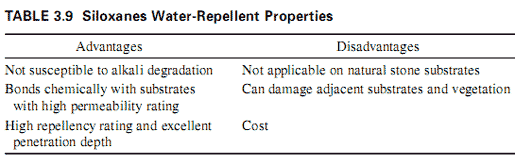
Siloxanes, as other silicone-based products, may not be used with certain natural stones such as limestone. They also are not applicable to gypsum products or plaster. Siloxanes should not be applied over painted surfaces, and if surfaces are to be painted after treatment they should first be tested for compatibility. (See Table 3.9.)

Siloxanes Water-Repellent Properties

Silicone rubber

These systems are a hybrid of the basic silicone film-forming and the silicone derivatives penetrating sealers. The product is basically a silicone solid dissolved in a solvent carrier that penetrates into the substrate, carrying the solids to form a solid film that is integral with the substrate. Unlike the penetrating derivatives, silicone rubbers do not react with the substrate to form the repellency capability.

The percentage solids, as high as 100 percent, carried into the substrate supposedly create a thickness of product millage internally in the substrate to a film thick enough to bridge minute hairline cracking in the substrate. This elongation factor, expressed as high as 400 percent by some manufacturers, does not produce substantial capacity to bridge cracks, since the millage of the film that creates movement capability is minimal with clear repellents. Only existing cracks less than 1/ 32 in are within the capability of these materials to seal, and new cracks that develop will not be bridged since the material is integral with the substrate and cannot move as film-forming membranes are allowed to do.

Through chemical formulations and the fact that they penetrate into the substrate, the silicone rubber products have been UV-retardant, unlike basic silicone film-forming sealers. At the same time they retain sufficient permeability ratings to permit applications to typical clear repellent substrates. These systems are also applicable to wood, canvas, and terra cotta substrates that other penetrating sealers are not applicable, since the rubber systems do not have to react with the substrate to form their repellency.

Silicone rubber systems are applicable in both horizontal and vertical installations and make excellent sealers for civil project sealing including bridges, overpasses, and parking garages. Like the generic silicone compounds, silicone rubber does not permit any other material to bond to it directly. Therefore, projects sealed with these materials can not be painted over in the future without having to remove the sealer with caustic chemicals such as solvent paint removers. This can create problems on projects where some applications are required over the substrate once sealed, such as parking-stall painted stripes in a parking garage. Manufacturers of the silicone rubber sealers should be contacted directly for  recommendations in such cases.

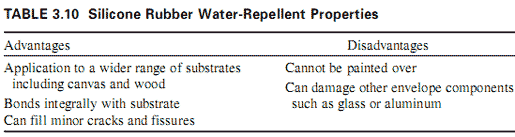
These materials generally have excellent repellency rates in addition to acceptable permeability rates. Overspray precautions should be taken whenever using the product near glass or aluminum envelope components, since the material is difficult if not almost impossible to remove from such substrates. (See Table 3.10).


 Silicone Rubber Water-Repellent Properties

Sodium silicates

Sodium silicate materials should not be confused with water repellents. They are concrete densifiers or hardeners. Sodium silicates react with the free salts in concrete such as calcium or free lime, making the concrete surface more dense. Usually these materials are sold as floor hardeners, which when compared to a true, clear deck coating have repellency insufficient to be considered with materials of this section.

Monday, May 20, 2013

CLEAR REPELLENTS - WATERPROOFING SYSTEMS

Although clear sealers do not fit the definition of true waterproofing systems, they do add water repellency to substrates where solid coatings as an architectural finish are not acceptable (see Fig. 3.2.). Clear sealers are applied on masonry or concrete finishes when a repellent that does not change substrate aesthetics is required. Clear sealers are also specified for use on natural stone substrates such as limestone. Water repellents prevent chloride ion penetration into a substrate and prevent damage from the freeze–thaw cycles.


 Repellency of sealer application.
FIGURE 3.2 Repellency of sealer application.
There is some disagreement over the use of sealers in historic restoration. Some prefer stone and masonry envelope components to be left natural, repelling or absorbing water and aging naturally. This is more practical in older structures that have massive exterior wall substrates than in modern buildings. Today exterior envelopes are as thin as  1 8 inch, requiring additional protection such as clear sealers.

The problem with clear sealers is not in deciding when they are necessary but in choosing a proper material for specific conditions. Clear repellents are available in a multitude of compositions, including penetrates and film-forming materials. They vary in percentage of solids content and are available in tint or stain bases to add uniformity to the substrate color.

The multitude of materials available requires careful consideration of all available products to select the material appropriate for a particular situation. Repellents are available in the compositions and combinations shown in Table 3.2. Sealers are further classified into penetrating and film-forming sealers.


Repellent Types and Compositions
Clear sealers will not bridge cracks in the substrate, and this presents a major disadvantage in using these materials as envelope components. Should cracks be properly pre- pared in a substrate before application, effective water repellency is achievable. However, should further cracking occur, due to continued movement, a substrate will lose its watertightness. Properly designed and installed crack-control procedures, such as control joints and expansion joints, alleviate cracking problems.

Figure 3.3 shows a precast cladding after rainfall with no sealer applied. Water infil- trating the precast can enter the envelope and bypass sealant joints into interior areas.

Figure 3.4 demonstrates just how effective sealers can be in repelling water.

Precast concrete building with no sealer permits water absorption.
FIGURE 3.3 Precast concrete building with no sealer permits water absorption.
Effectiveness of sealer application is evident after a rainfall.
FIGURE 3.4 Effectiveness of sealer application is evident after a rainfall.
 Film-forming sealers

Film-forming, or surface, sealers have a viscosity sufficient to remain primarily on top of a substrate surface. Penetrating sealers have sufficiently low viscosity of the vehicle (binder and solvent) to penetrate into masonry substrate pores. The resin molecule sizes of a sealer determine the average depth of penetration into a substrate.

Effectiveness of film-forming and penetrating sealers is based upon the percentage of solids in the material. High-solid acrylics will form better films on substrates by filling open pores and fissures and repelling a greater percentage of water. Higher-solids-content materials are necessary when used with very porous substrates; however, these materials may darken or impart a glossy, high sheen appearance to a substrate.

Painting or staining over penetrating sealers is not recommended, as it defeats the purpose of the material. With film-forming materials, if more than a stain is required, it may be desirable to use an elastomeric coating to achieve the desired watertightness and color.

Most film-forming materials and penetrates are available in semitransparent or opaque formulations. If it is desired to add color or a uniform coloring to a substrate that may contain color irregularities (such as tilt-up or poured-in-placed concrete), these sealers offer effective solutions. (See Table 3.3)

Film-Forming Sealer Properties

Penetrating sealers

Penetrating sealers are used on absorptive substrates such as masonry block, brick, concrete, and porous stone. Some penetrating sealers are manufactured to react chemically with these substrates, forming a chemical bond that repels water. Penetrating sealers are not used over substrates such as wood, glazed terra cotta, previously painted surfaces, and exposed aggregate finishes.

On these substrates, film-forming clear sealers are recommended (which are also used on masonry and concrete substrates). These materials form a film on the surface that acts as a water-repellent barrier. This makes a film material more susceptible to erosion due to ultraviolet weathering and abrasive wear such as foot traffic.

Penetrating sealers are breathable coatings, in that they allow water vapor trapped in a substrate to escape through the coating to the exterior. Film-forming sealers’ vapor trans- mission (perm rating) characteristics are dependent on their solids content. Vapor trans- mission or perm ratings are available from manufacturers. Permeability is an especiallyimportant characteristic for masonry installed at grade line. Should an impermeable coating be applied here, moisture absorbed into masonry by capillary action from ground sources will damage the substrates, including surface spalling.

Many sealers fail due to a lack of resistance to alkaline conditions found in concrete and masonry building materials. Most building substrates are high in alkalinity, which causes a high degree of failure with poor alkaline-resistant sealers.

Penetrating materials usually have lower coverage rates and higher per-gallon costs than film materials. Penetrating sealers, however, require only a one-coat application versus two for film-forming materials, reducing labor costs.

Penetrating and film-forming materials are recognized as effective means of preventing substrate deterioration due to acid rain effects. They prevent deterioration from air and water pollutants and from dirt and other contaminants by not allowing these pollutants to be absorbed into a substrate. (See Table 3.4.)

Penetrating Sealer Properties

Thursday, May 16, 2013

ABOVE-GRADE EXPOSURE PROBLEMS - WATERPROOF SYSTEMS IN BUILDINGS

All above-grade waterproof systems are vulnerable to a host of detrimental conditions due to their exposure to weathering elements and substrate performance under these conditions. Exposure of the entire above-grade building envelope requires resistance from many severe effects, including the following:

● Ultraviolet weathering
● Wind loading
● Structural loading due to snow or water
● Freeze–thaw cycles
● Thermal movement
● Differential movement
● Mildew and algae attack
● Chemical and pollution attack from chloride ions, sulfates, nitrates, and carbon dioxide Chemical and pollution attack is becoming ever more frequent and difficult to contend with. Chloride ions (salts) are extremely corrosive to the reinforcing steel present in all structures, whether it is structural steel, reinforcing steel, or building components such as shelf angles.

Even if steel is protected by encasement in concrete or is covered with a brick facade, water that penetrates these substrates carries chloride ions that attack the steel. Once steel begins to corrode it increases greatly in size, causing spalling of adjacent materials and structural cracking of substrates.

All geographic areas are subject to chloride ion exposure. In coastal areas, salt spray is concentrated and spread by wind conditions; in northern climates, road salts are used during winter months. Both increase chloride quantities available for corrosive effects on envelope components.

Acid rain now affects all regions of the world. When sulfates and nitrates present in the atmosphere are mixed with water, they create sulfuric and nitric acids (acid rain), which affect all building envelope components. Acids attack the calcium compounds of concrete and masonry surfaces, causing substrate deterioration. They also affect exposed metals on a structure such as flashing, shelf angles, and lintel beams.

Within masonry or concrete substrates, a process of destructive weathering called car- bonation occurs to unprotected, unwaterproofed surfaces. Carbonation is the deterioration of cementitious compounds found in masonry substrates when exposed to the atmospheric pollutant carbon dioxide (automobile exhaust).

Carbon dioxide mixes with water to form carbonic acid, which then penetrates a masonry or concrete substrate. This acid begins deteriorating cementitious compounds that form part of a substrate.

Carbonic acid also causes corrosion of embedded reinforcing steel such as shelf angles by changing the substrate alkalinity that surrounds this steel. Reinforcing steel, which is normally protected by the high alkalinity of concrete, begins to corrode when carbonic acid change lowers alkalinity while also deteriorating the cementitious materials.

Roofing systems will deteriorate because of algae attack. Waterproof coatings become brittle and fail due to ultraviolet weathering. Thermal movement will split or cause cracks in a building envelope. This requires that any waterproof material or component of the building envelope be resistant to all these elements, thus ensuring their effectiveness and, in turn, protecting a building during its life-cycling.

Finally, an envelope is also subject to building movement, both during and after construction. Building envelope components must withstand this movement; otherwise, designs must include allowances for movement or cracking within the waterproofing material.

Cracking of waterproofing systems occur because of structural settlement, structuralloading, vibration, shrinkage of materials, thermal movement, and differential movement.

To ensure successful life-cycling of a building envelope, allowances for movement must be made, including expansion and control joints, or materials must be chosen that can withstand expected movement.

All these exposure problems must be considered when choosing a system for water- proofing above-grade envelope portions. Above-grade waterproofing systems include the following horizontal and vertical applications:

● Vertical
● Clear repellents
● Cementitious coatings
● Elastomeric coatings
● Horizontal
● Deck coatings
● Clear deck sealers
● Protected membranes

Monday, May 13, 2013

WATERPROOFING HORIZONTAL APPLICATIONS

Several types of systems and products are available for horizontal above-grade applications, such as parking garages and plaza decks. Surface coatings, which apply directly to exposed surfaces of horizontal substrates, are available in clear siloxane types or solid coatings of urethane or epoxy. Clear horizontal sealers, as with vertical applications, do not change existing substrate aesthetics to which they are applied. They are, however, not in themselves completely waterproof but only water-resistant.

Clear coatings are often specified for applications, to prevent chloride ion penetration into concrete substrates from such materials as road salts. These pollutants attack rein- forcing steel in concrete substrates and cause spalling and structural deterioration.

Urethane, epoxy, or acrylic coatings change the aesthetics of a substrate but have elastomeric properties that allow bridging of minor cracking or substrate movement. Typically, these coatings have a “wearing coat” that contains silicon sand or carbide, which allows vehicle or foot traffic while protecting the waterproof base coat.

Subjecting coatings to foot or vehicular wear requires maintenance at regular frequency and completion of necessary repairs. The frequency and repairs are dependent on the  type and quantity of traffic occurring over the envelope coating.

As with vertical materials, attention to detailing is necessary to ensure watertightness.

Expansion or control joints must be properly sealed, cracks or spalls in the concrete must be repaired before application, and allowances for drainage must be created.

Several types of waterproof membranes are available for covered decks such as sand- wich slab construction or tile-topped decks. These membranes are similar to those used in below-grade applications, including liquid-applied and sheet-good membranes. Such applications are also used as modified roofing systems.

Thursday, May 9, 2013

WATERPROOFING VERTICAL APPLICATIONS

Several systems are available for weatherproofing vertical wall envelope applications. Clear sealers are useful when substrate aesthetics are important. These sealers are typically applied over precast architectural concrete, exposed aggregate, natural stone, brick, or masonry.

It is important to note that clear sealers are not completely waterproof; they merely slow down the rate of water absorption into a substrate, in some situations as much as 98 percent.

However, wind-driven rain and excessive amounts of water will cause eventual leakage through any clear sealer system. This requires flashings, dampproofing, sealants, and other systems to be used in conjunction with sealers, to ensure drainage of water entering through primary envelope barriers.

This situation is similar to wearing a canvas-type raincoat. During light rain, water runs off; but should the canvas become saturated, water passes directly through the coat. Clear sealers as such are defined as water repellents, in that they shed water flow but are not impervious to water saturation or a head of water pressure.

Elastomeric coatings are high-solid-content paints that produce high-millage coatings when applied to substrates. These coatings are waterproof within normal limitations of movement and proper application.

Elastomeric coatings completely cover and eliminate any natural substrate aesthetics. They can, however, add a texture of their own to an envelope system, depending on the amount of sand, if any, in the coating.

To waterproof adequately with an elastomeric coating, details must be addressed, including patching cracks or spalls in substrates, allowing for thermal movement, and installation of flashings where necessary.

Cementitious coatings are available for application to vertical masonry substrates, which also cover substrates completely. The major limitation of cementitious above-grade product use is similar to its below-grade limitation. The products do not allow for any substrate movement or they will crack and allow water infiltration. Therefore, proper attention to details is imperative when using cementitious materials. Installing sealant joints for movement and crack preparation must be completed before cementitious coating application.

With all vertical applications, there are patching materials used to ensure water tightness of the coating applied. These products range from brushable-grade sealants for small cracks, to high-strength, quick-set cementitious patching compounds for repairing spalled substrate areas.

Monday, May 6, 2013

WATERPROOFING DIFFERENCES FROM BELW-GRADE SYSTEMS

Most above-grade materials are breathable in that they allow for negative vapor transmission.
This is similar to human skin; it is waterproof, allowing you to swim and bathe but also to perspire, which is negative moisture transmission. Most below-grade materials will not allow negative transmission and, if present, it will cause the material to blister or become unbonded.

Breathable coatings are necessary on all above-grade wall surfaces to allow moisture condensation from interior surfaces to pass through wall structures to the exterior. The sun causes this natural effect by drawing vapors to the exterior. Pressure differentials that might exist between exterior and interior areas create this same condition.

Vapor barrier (nonbreathable) products installed above grade cause spalling during freeze–thaw cycles. Vapor pressure buildup behind a nonbreathable coating will also cause the coating to disbond from substrates. This effect is similar to window or glass areas that are vapor barriers and cause formation of condensation on one side that cannot pass to exterior areas.

Similarly, condensation passes through porous wall areas back out to the exterior when a breathable coating is used, but condenses on the back of nonbreathable coatings. This buildup of moisture, if not allowed to escape, will deteriorate structural reinforcing steel and other internal wall components.

Below-grade products are neither ultraviolet-resistant nor capable of withstanding thermal movement experienced in above-grade structures. Whereas below-grade materials are not subject to wear, above-grade materials can be exposed to wear such as foot traffic.

Below-grade products withstand hydrostatic pressure, whereas above-grade materials do not. Waterproofing systems properties are summarized in Table 3.1.

Waterproofing Systems Differences

Since many waterproofing materials are not aesthetically acceptable to architects or engineers, some trade-off of complete watertightness versus aesthetics is used or specified. For instance, masonry structures using common face brick are not completely waterproof due to water infiltration at mortar joints. Rather than change the aesthetics of brick by applying a waterproof coating, the designer chooses a dampproofing and flashing system. This damp-proofing system diverts water that enters through the brick wall back out to the exterior.

Application of a clear water repellent will also reduce water penetration through the brick and mortar joints. Such sealers also protect brick from freeze–thaw and other weathering cycles.

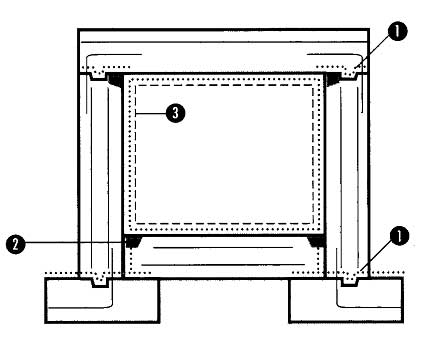
Thus, waterproofing exposed vertical and horizontal building components can include a combination of installations and methods that together compose a building envelope. This is especially true of buildings that use a variety of composite finishes for exterior surfacing such as brick, precast, and curtain wall systems. With such designs, a combination of several waterproofing methods must be used. Although each might act independently, as a whole they must act cohesively to prevent water from entering a structure. Sealants, wall flashings, weeps, dampproofing, wall coatings, deck coatings, and the natural weathertightness of architectural finishes themselves must act together to prevent water intrusion (Fig. 3.1).

This chapter will cover vertical waterproofing materials, including clear water repellents, elastomeric coatings, cementitious coatings, and related patching materials. It will also review horizontal waterproofing materials including deck coatings, sandwich slab membranes, and roofing.

All envelope waterproofing applications must act together to prevent water intrusion.
FIGURE 3.1 All envelope waterproofing applications must act together to prevent water intrusion.

Thursday, May 2, 2013

BUILDING - ABOVE-GRADE WATERPROOFING

INTRODUCTION

Waterproofing of surfaces above grade is the prevention of water intrusion into exposed elements of a structure or its components. Above-grade materials are not subject to hydrostatic pressure but are exposed to detrimental weathering effects such as ultraviolet light.

Water that penetrates above-grade envelopes does so in five distinct methods:
● Natural gravity forces
● Capillary action
● Surface tension
● Air pressure differential
● Wind loads

The force of water entering by gravity is greatest on horizontal or slightly inclined enve- lope portions. Those areas subject to ponding or standing water must be adequately sloped to provide drainage away from envelope surfaces.

Capillary action is the natural upward wicking motion that can draw water from ground sources up into above-grade envelope areas. Likewise, walls resting on exposed horizontal portions of an envelope (e.g., balcony decks) can be affected by capillary action of any ponding or standing water on these decks.

The molecular surface tension of water allows it to adhere to and travel along the under- side of envelope portions such as joints. This water can be drawn into the building by gravity or unequal air pressures.

If air pressures are lower inside a structure than on exterior areas, water can be literally sucked into a building. Wind loading during heavy rainstorms can force water into interi- or areas if an envelope is not structurally resistant to this loading. For example, curtain walls and glass can actually bend and flex away from gaskets and sealant joints, causing direct access for water.

The above-grade envelope must be resistant to all these natural water forces to be water- tight. Waterproofing the building envelope can be accomplished by the facade material itself (brick, glass, curtain wall) or by applying waterproof materials to these substrates. Channeling water that passes through substrates back out to the exterior using flashing, weeps, and damp-proofing is another method. Most envelopes include combinations of all these methods.

Older construction techniques often included masonry construction with exterior load bearing walls up to 3-ft thick. This type of envelope required virtually no attention to waterproofing or weathering due to the shear impregnability of the masonry wall.

Today, however, it is not uncommon for high-rise structures to have an envelope skin thickness of  1 8 in. Such newer construction techniques have developed from the need for lighter-weight systems to allow for simpler structural requirements and lower building costs.

These systems, in turn, create problems in maintaining an effective weatherproof envelope.
Waterproof building surfaces are required at vertical portions as well as horizontal applications such as balconies and pedestrian plaza areas. Roofing is only a part of necessary above-grade waterproofing systems, one that must be carefully tied into other building envelope components.

Today roofing systems take many different forms of design and detailing. Plaza decks or balcony areas covering enclosed spaces and parking garage floors covering an occupied space all constitute individual parts of a total roofing system. Buildings can have exposed roofs as well as unexposed membranes acting as roofing and waterproofing systems for preventing water infiltration into occupied areas.

Monday, April 29, 2013

VAPOR BARRIERS - USE IN CONSTRUCTION WORK

Vapor barriers are not suitable for waterproofing applications. As their name implies, they prevent transmission of water vapor through a substrate in contact with the soil. Typically used at slabs-on-grade conditions, they also are used in limited vertical applications.

Vapor barriers are sometimes used in conjunction with other waterproofing systems, where select areas of the building envelope are not subject to actual water penetration.

Vapor barriers are discussed only to present their differences and unsuitability for envelope waterproofing.

As previously discussed, soils have characteristic capillary action that allows the upward movement or migration of water vapor through the soil. Beginning as water and saturating the soil immediately adjacent to the water source, the capillary action ends as water vapor in the upper capillary capability limits of the soil.

Vapor barriers prevent upward capillary migration of vapor through soils from penetrating pores of concrete slabs. Without such protection, delamination of flooring materials, damage to structural components, paint peeling, mildew formation, and increased humidity in finished areas will occur. Vapor barriers can also prevent infiltration by alkaline salts into the concrete slab and flooring finish.

Vapor barriers are produced in PVC, combinations of reinforced waterproof paper with a polyvinyl coating, or polyethylene sheets (commonly referred to as  visquene).

Polyethylene sheets are available in both clear and black colors in thicknesses ranging from 5 to 10 mil. PVC materials are available in thickness ranging from 10 to 60 mil.

Typical properties of vapor barriers are summarized in Table 2.9.


Material Properties of Vapor Barriers

Vapor barriers are rolled or spread out over prepared and compacted soil, with joints lapped 6 in. Vapor barriers can be carried under, up, and over foundations to tie horizontal floor applications into vertical applications over walls. This is necessary to maintain the integrity of a building envelope.

Mastics are typically available from manufacturers for adhering materials to vertical substrates. In clay soil, where capillary action is excessive, laps should be sealed with a mastic for additional protection. Proper foundation drainage systems should be installed, as with all waterproofing systems.

Vapor barriers are installed directly over soil, which is not possible with most waterproofing systems. Protection layers or boards are not used to protect the barrier during reinforcement application or concrete placement.